Venezuelan Diaspora to Trump: Finish the Job
Ultimately, demonstrators within the Venezuelan diaspora want the Trump administration to finish what it started in Venezuela rather than accepting a transition that amounts to the same regime under a new figurehead. Documentation from human rights defenders and NGOs tells a vastly different story from what Rodríguez is claiming. If this evidence holds up, then the issue facing Venezuela is not merely a change in leadership but the further entrenchment of the existing autocratic regime.
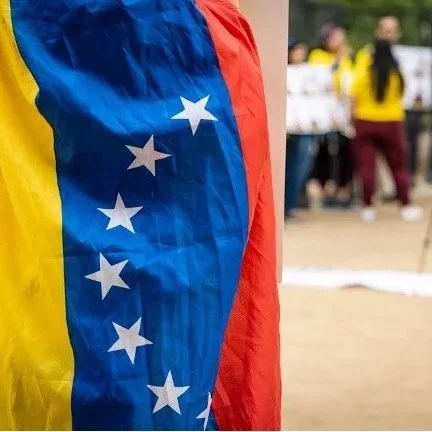
Photo by Elizabeth Kollmar at the April 25th demonstration attended by the author and are used with her kind permission.
On April 25th, members of the Venezuelan diaspora and civic communities gathered in front of the White House with a list of over 500 political prisoners who are still held in Venezuela. Several reports from activists and community organizations dispute the claims of stability and argue that Venezuela’s acting president, Delcy Rodríguez, is contributing to more repression. Some fear a “Russian transition” whereby the authoritarian structure does not collapse but stabilizes. These protests, organized by diaspora groups who wanted to boost voices inside Venezuela, called for freedom for political prisoners and appealed to Trump to hold Rodríguez accountable. From property seizures to extrajudicial executions and continued political imprisonment, these records contradict the claim that Rodríguez is bringing stability.
In January 2026, the United States conducted a military operation to capture the disputed Venezuelan leader Nicolas Maduro and his wife Cilia Flores. Maduro has not been recognized as the legitimate governing authority in Venezuela since 2019. The United States recognized the National Assembly and the president of the national assembly, Juan Guaido, who leveraged diplomatic powers when engaging with other countries. The 2024 Venezuela elections were condemned as fraudulent by human rights agencies such as the Human Rights Foundation, the Carter Center, and Amnesty International. The opposition candidate, Edmundo Gonzalez, won but had no means of taking power or securing diplomatic recognition. In the wake of the election, over one thousand activists and journalists were arrested, including Maria Oropeza, who livestreamed her arrest; Juan Guanipa and Freddy Superlano, both leading opposition politicians; journalists such as Roland Carreno; and civil society leaders and human rights defenders such as Jesus Armas and Rocio San Miguel.
Most of the opposition is in exile or prison. Delcy Rodríguez, who was Maduro’s vice president, was placed in charge. While she agreed to the release of several high-profile political prisoners, many remain behind bars according to human rights groups on the ground. As reported by local sources and Leopoldo López’s wife, Lilian Tintori, in an interview with CNN, Rodríguez ordered the destruction of the opposition leader’s home including over a thousand books, personal items, children’s toys, and religious items. This operation also allegedly resulted in the disappearance of the family’s pets, whose fate remains unknown. Furthermore, Delcy Rodríguez cancelled López’s Venezuelan citizenship, an unprecedented step in Venezuelan history and one that is contradictory to Venezuelan law, which prohibits revocation of citizenship by birth. Both López and Tintori have extensively documented intimidation by Venezuelan authorities, including character assassination campaigns, physical harassment, and forced exile. The former was held as a political prisoner for seven years and was subjected to torture. In recent years he has faced relentless campaigns of character assassination, “psychological torment,” forced exile, and the arbitrary deprivation of his citizenship—documented by the UN Independent International Fact-Finding Mission on Venezuela and Anne Applebaum’s Autocracy, Inc.; now he faces the destruction of his belongings and the unknown state of his two dogs. According to human rights agencies, this action conflicts with the narrative of stabilization. Moreover, Cazadores de Fake News confirmed that the entire propaganda apparatus is still in place.
What is currently at stake in Venezuela is the risk that Delcy Rodríguez becomes permanently entrenched while the regime remains fundamentally unchanged.
Delcy enacted an “Amnesty Law” that was criticized by various oppositionfactions as well as the Cato Institute. Foro Penal confirmed it freed about 186 political prisoners, but around 500 remain behind bars. This law excludes military personnel who supported the opposition and does not apply to opposition leaders in exile like Leopoldo López and Maria Corina Machado. The Amnesty Law also mentions that those involved are “criminals,” and presumes guilt. Opposition activist David Smolansky condemned this framing, arguing that the regime fabricated the crimes and abandoned the presumption of innocence.
German Flores, a Venezuelan pastor in exile, mentioned that this event is the culmination of what has been building for the other twenty-seven years of Chavismo. He said that forced disappearances without due process or presumption of innocence is a common occurrence. According to Linda, a young Venezuelan diaspora civic leader, an incident occurred where seven political prisoners died; officials claimed, “there was a riot,” but no sources confirmed or verified how these deaths occurred. Mr. Flores mentioned that for a transition to happen, there needs to be reconciliation—but that that will not happen until the regime acknowledges wrongdoing. Mr. Flores continued to emphasize that “forgiveness and the spiritual side is very important, revenge is dangerous,” when discussing the pitfalls of transition. Linda and Zuleka, two Venezuelan women, mentioned how they have immense gratitude for President Trump and that they would like him to “finish the job” and hold Ms. Rodríguez accountable.
What is currently at stake in Venezuela is the risk that Delcy Rodríguez becomes permanently entrenched while the regime remains fundamentally unchanged. The problems that existed under Maduro, such as Iranian, Chinese, and Russian involvement, will continue. As of May 2026, no dates for elections have been called, and political leaders are still in exile and without homes to return to. Diaspora members want to return, but given this situation are hesitant. In addition to the hundreds of Venezuelan political prisoners still in captivity, the regime recently revealed that a political prisoner died in July 2025, the news of which was withheld from his elderly mother until May 2026. His mother died of shock shortly after. Ongoing reports such as this, cancellations of citizenship by birth, the withholding of amnesty from political dissidents, and reports of torture continuing from El Helicoide, contradict the narrative of stabilization. Moreover, reports of repression from Foro Penal, Cazadores de Fake News, Un Mundo Sin Mordaza, and Defende Venezuela continue to document repression and the taking of political prisoners, casting doubt on claims of a stabilized Venezuela. For policymakers, a smart strategy that would align with US interests would be
1) Ensuring that there is a timeline for fair and free elections, or that Edmundo Gonzalez is finally sworn in, given his 2024 victory;
2) Calling for a release of all political prisoners and true amnesty for those accused of political crimes;
3) Restoring the citizenship of Leopoldo López and others deprived of it, as well as rebuilding the properties of opposition leaders and recovering lost belongings so they can return home.
Ultimately, demonstrators within the Venezuelan diaspora want the Trump administration to finish what it started in Venezuela rather than accepting a transition that amounts to the same regime under a new figurehead. Carrie Filipetti, Executive Director of the Vandenberg Coalition, expressed concern over Rodríguez’s track record, as did Ambassador James Story who has had direct experience in Venezuela. Both Filipetti and Story agreed that the problems will continue, since, according to them, this is the same regime with a new face. True stability requires political stabilization, and it cannot happen if the actors who caused the destabilization are continuing the same repression. Moreover, documentation from human rights defenders and NGOs tells a vastly different story from what Rodríguez is claiming. If this evidence holds up, then the issue facing Venezuela is not merely a change in leadership but the further entrenchment of the existing autocratic regime.